

At a Glance
- The differences and unique applications of the three main blow-molding methods
- Raw material considerations, from toughness and weight to chemical resistance
- Common defects in blow molded products and how to correct them
There are essentially three widely used technologies for manufacturing plastic products: Injection molding, extrusion, and blow molding.
Injection molding is the most commonly used process for the mass production of plastic products and involves injecting a molten polymer into a mold. As the plastic hardens, it forms a finished part. The types of products are seemingly limitless, and while the upfront cost of the equipment and mold is substantial, injection molding can repeatably produce high-quality parts in the millions at exceptionally fast cycle times.
In extrusion, the polymer melt is pushed through a die to form a profile or tube. Tooling and equipment costs are a fraction of injection molding. Extrusion is typically used to produce tubing for medical and other applications, straws, and profiles for windows.
In blow molding, which is the focus of this article, air is blown into a heated plastic tube, called a parison, to form hollow plastic products. Plastic bottles are a key application. Want to know more? You’ve come to the right place.
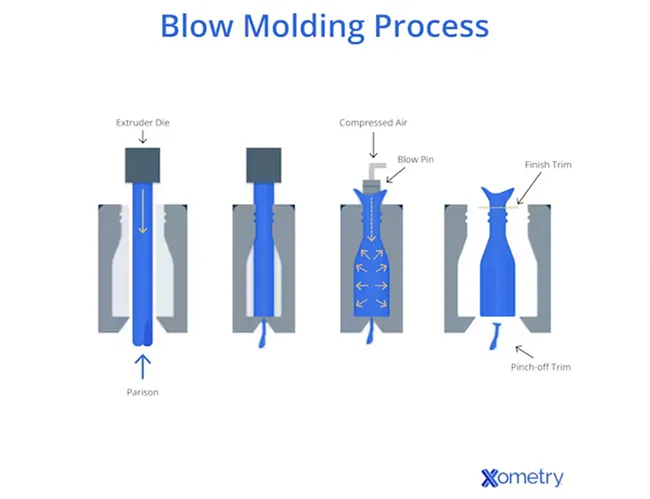
The blow molding process. Image courtesy of www.xometry.com.
The types of blow molding
You might say that blow molding has its origins as far back as the 1st century BC, when it was invented by Syrian glassmakers, according to Britannica. The technique involves putting a gob of molten glass on one end of a hollow tube and blowing air into it from a mouthpiece on the other end. The glass takes on a preliminary shape and is then lowered into a mold and inflated by blowing until it has assumed the desired shape and pattern. In essence, plastic blow molding in its most primitive form is similar.
There are essentially three types of blow molding: Injection blow molding, extrusion blow molding, and stretch blow molding.
Blow molding company Custom-Pak describes the technologies, as follows, on its website.
Injection blow molding is typically used to make plastic — mostly polyethylene terephthalate (PET) — bottles in large quantities. First a pre-form — which looks like a test tube with a thread detail on the open end — is molded. The pre-form is then placed in a mold where it is reheated and blown into the finished bottle shape.
Stretch blow molding is a variation of injection blow molding, the difference being that the pre-form is both blown and stretched. As Custom-Pak describes it: “The core rod increases the length of the pre-form as air is forced into it so that the product lengthens and widens at the same time to fill the mold cavity. The core rod stops lengthening near the opposite wall of the mold.”
Extrusion blow molding is suited for making more complex parts that are beyond the capabilities of either form of injection blow molding. The two main types of extrusion blow molding are continuous and intermittent.
In continuous extrusion blow molding, the molten plastic is forced through a die, creating a continuous tube called a parison. It is placed inside a mold where pressurized air is blown into the parison until it fills the mold cavity and takes on the desired shape. Once it has cooled, the molded part is removed for secondary processing, notably removal of excess plastic, called flash.
Intermittent extrusion blow molding involves pushing the resin from the extruder into an accumulator head, where a set amount of molten plastic collects in a chamber and is expelled by a pair cylinders, which also control the shape of the plastic. Custom-Pak further explains that when the volume of resin pushed into the accumulator reaches the capacity needed for the part, the molten plastic is forced through an extrusion die around a core, called a mandrel or pin. This creates a tube that determines the inner diameter inside of a perimeter ring, which creates the outer diameter. The dies are moveable so the wall thickness in the tubular parison can be changed as it is formed or shot from the accumulator head, allowing maximum control of the finished product detail.
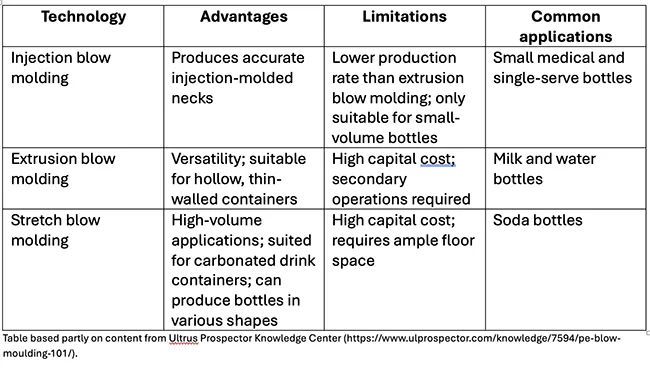
The advantages, limitations, and most common applications of the three main forms of blow molding.
Melting the plastic resin
A range of plastics are suitable for the blow molding process, and the specific type and grade of plastic selected depends largely on the end application. Materials and their typical applications will be addressed in a later section.
Regardless of the selected material, the plastic resin first must be heated to its melting point. The raw material in the form of plastic pellets is fed into an extruder at a controlled rate and temperature and is shaped into a parison, a hollow tube with an opening at one end. The parison is placed in a mold and inflated by air. Once the blow molded part has cooled, it is sent on its way for any secondary processing, if needed.
Primary materials used in plastic blow molding
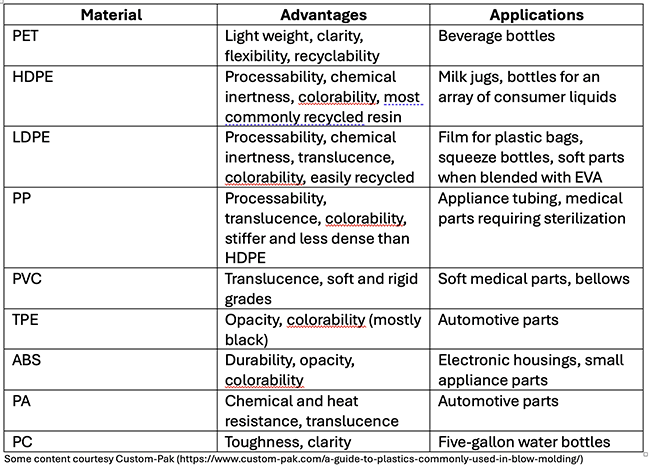
The advantages and applications of commonly used blow molding materials.
Polyolefins are the most widely used polymers in blow molding applications. The overall advantages of this polymer group compared with other plastics include processability, light weight, toughness, chemical resistance, and cost, according to materials supplier LyondellBasell.
Polyolefins that can be blow molded, according to LyondellBasell, include:
-
High-, medium-, low, and linear-low-density polyethylene
-
Ethylene copolymers, such as ethylene vinyl acetate
-
Polypropylene and propylene copolymers
-
Polythethylene terephthalate (PET), which belongs to the polyester family, is also widely used in blow molding.
-
High-density polyethylene (HDPE) is the most commonly used plastic in the world and is also the number one polymer for blow molding. You probably encounter HDPE multiple times a day, when you grab a water or milk bottle, for example. It is also commonly used in other forms of packaging and to manufacture everything from hardhats to children’s toys. The global HDPE market is projected to reach a CAGR of 5.7% through 2032, according to a market report from DataIntelo. The material’s combination of light weight, durability, and recyclability make it a popular choice, according to Shell, which supplies the raw material. “HDPE has incredible toughness, allowing manufacturers to mold and transform the resin into a variety of designs,” writes Shell on its website. Moreover, that toughness also helps protect products made with HDPE, which won’t shatter – or even suffer any noticeable damage – when dropped to the ground. HDPE can also survive all kinds of harsh climates, from the hottest deserts to the coldest tundras. In fact, NASA is counting on HDPE to shield astronauts and their spacecraft from dangerous cosmic rays and radiation. HDPE is among the most commonly recycled resins. Also, HDPE’s chemically inert nature makes it a popular food-grade plastic.
-
Low-density (LD) PE is impact-, stain-, and water-resistant and can also be used to manufacture beverage and food packaging as well as plastic bags.
-
Polythethylene terephthalate (PET) is also widely used to blow mold water and soft drink bottles, specifically clear containers. As noted above, PET is typically injection blow molded. While it is not impossible to extrusion blow mold PET, it is uncommon because the resin requires extensive drying, according to Custom-Pak.
-
Polypropylene (PP) is especially well suited for blow molding parts that are exposed to elevated temperatures, notably dishwasher, automotive, and medical applications. Known for its processability, colorability, and affordability, PP also has high flexural strength.
-
Soft PVC is typically used to blow mold medical parts, bellows, and related products, but the material has come under scrutiny for perceived risks to human health. If there are risks, it should be noted that it is primarily because of the phthalate-based plasticizers used to soften the material, not the material itself. PVC, it is often noted, has undergone the most extensive in-vivo study of any polymer: It has been used for decades in medical applications, and the FDA and EU health agency have consistently given the material a clean bill of health.