


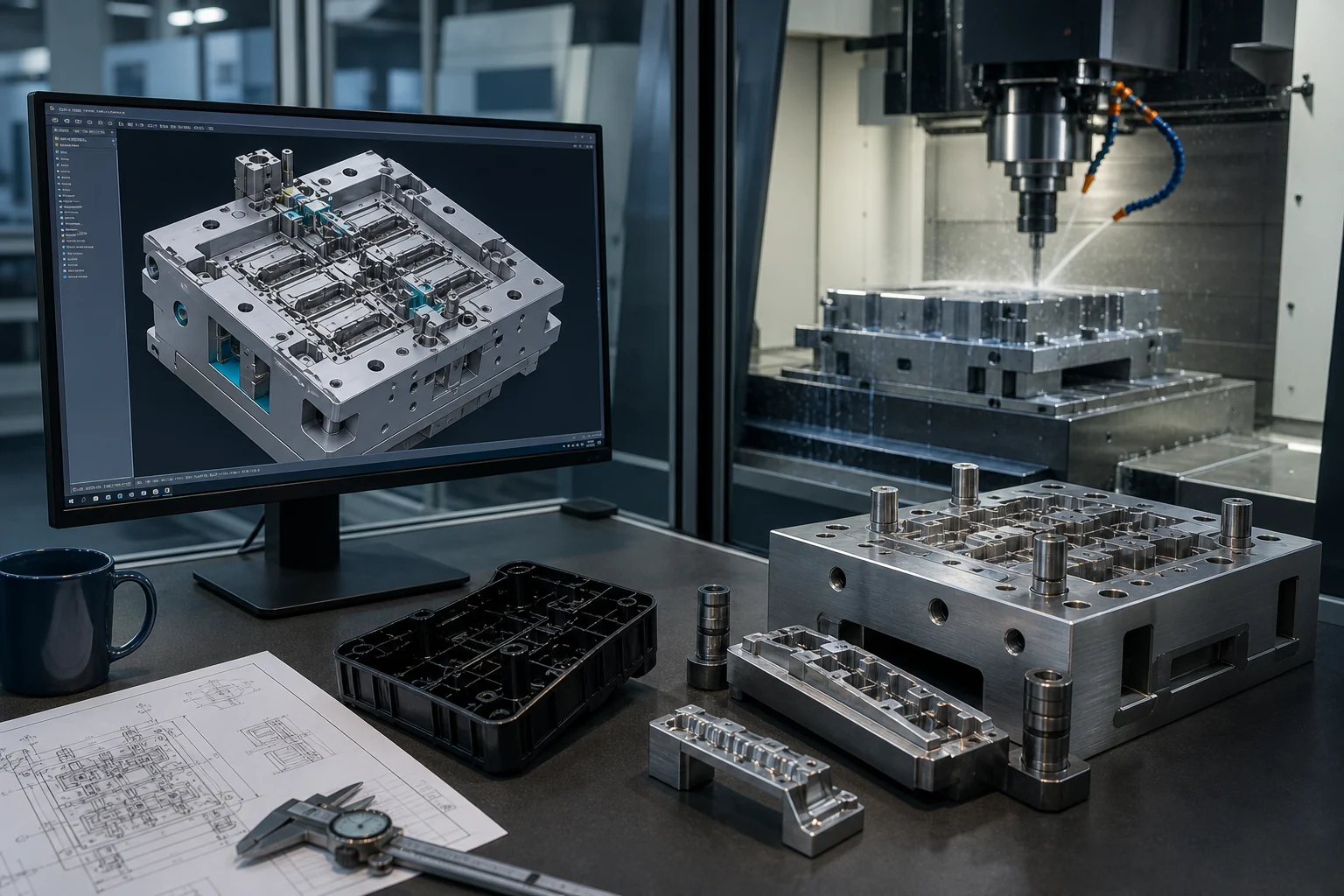
1. Requirements review and DFM
The project begins with more than a 3D file. The team should confirm resin grade, additives, color, annual volume, molding machine limits, cosmetic zones, dimensional tolerances, assembly interfaces and validation standards. DFM then checks draft, uniform wall thickness, weld lines, sink risk, deformation, gate position, ejection and cooling. Open questions are resolved before the mold layout is frozen, when changes are still fast and inexpensive.
2. Mold design and formal review
The detailed design defines parting line, cavity arrangement, runner, cooling circuits, slides, lifters, inserts, venting, sensors and maintenance access. Mold-flow analysis may be used to compare filling, pressure, temperature and warpage options. A formal review should record every decision, identify critical dimensions and confirm the molding machine interface. Only an approved design should release steel and start machining.
3. Steel preparation and precision machining
Steel certificates and hardness are verified on receipt. Rough machining leaves controlled allowance before heat treatment or stress relief; semi-finishing and finishing then establish the final geometry. CNC, EDM, wire cutting, grinding and polishing must follow common datums. In-process measurement catches errors while components can still be corrected economically. Electrodes, inserts and measurement reports should remain traceable to the current design revision.
4. Assembly and first mold trial
During assembly, technicians verify shutoffs, slide movement, ejection, cooling leakage, hot-runner wiring and safety features. The first trial is not simply a sample-making event. It records machine, material, drying, temperature, pressure, speed, cooling time and cycle data. Parts are inspected for short shots, flash, weld lines, sink, burn marks, warpage, dimensions and appearance. A fact-based trial report separates mold issues, process issues and product-design issues.
5. Optimization, validation and handover
Corrections are prioritized by function and risk. After each loop, the team repeats the relevant measurements and updates drawings. Final validation should use the agreed resin, machine and process window, with dimensional capability and an extended run when required. Handover includes approved samples, final drawings, bill of materials, steel and component certificates, inspection reports, process parameters, spare parts and maintenance guidance.
- Freeze requirements and DFM decisions before detailed design.
- Link critical product dimensions to mold and inspection datums.
- Record each machining and trial revision.
- Use trial data to distinguish tooling, process and part-design causes.
- Validate inside a documented molding window, not at one ideal setting.
- Deliver final data and preventive-maintenance requirements with the mold.
Stable production is designed into the process
A mold reaches production readiness when the product, tool and process are proven together. Skipping reviews may appear to save days early in the schedule, but often creates repeated trials and unpredictable corrections later. A milestone-based workflow gives both customer and manufacturer a shared view of risk, evidence and acceptance, making ramp-up faster and future maintenance more predictable.